
Augmentative and Alternative Communication (AAC) refers to all the ways people can communicate without using spoken words. It includes any method, system, or device that helps individuals who have difficulty with verbal speech or writing express themselves.
Augmentative Communication supports or enhances existing speech and Alternative Communication replaces speech entirely when it’s not functional or absent.
At ISLTS our Speech & Language Therapists use a variety of AAC tools to help our clients. These include;
Unaided AAC (no tools or devices needed)
- Gestures
- Facial expressions
- Sign language
Aided AAC (requires tools or equipment)
- Low-tech AAC: Picture boards, communication books, alphabet charts.
- High-tech AAC: Speech-generating devices, Apps on devices, Eye-tracking systems for individuals with limited mobility
High Tech AAC
In this article we are focusing on high tech AAC.
As is the case with many advances in technology, Augmentative and Alternative Communication (AAC) has revolutionised the way individuals with speech and language difficulties interact with the world. It offers a modern-day alternative to traditional communication methods like picture boards or sign language. These Apps offer various methods for expression, including text-to-speech, picture symbols, customisable vocabularies, and voice output features.
Some Apps are simple and icon-based, while others offer advanced capabilities like sentence prediction, switch access, and eye-tracking compatibility.
At ISLTS, our Speech & Language Therapists (SLTs) use AAC Apps with many clients and they are fast becoming an essential tool in our work. Most people now own a tablet or smartphone, so the Apps are easily accessible, however, AAC is not an independent solution and should always be part of a wider speech and language therapy plan.
We would always advise consulting with a Speech & Language therapist (SLT) to ensure the best AAC App match for each individual’s communication needs. Together we can choose the best AAC App and then tailor it to suit the user’s cognitive, motor, and linguistic needs.
7 Benefits of AAC Apps :
1. Enhancing Functional Communication
AAC Apps provide immediate and practical solutions for clients who cannot rely on speech. They help individuals express wants, needs, emotions and ideas, which significantly improves their quality of life.
2. Supporting Individualised Therapy Goals
Therapists can customise AAC Apps to meet the unique communication needs and abilities of each client, aligning with person-centered therapy plans.
3. Encouraging Language Development and Literacy
Some AAC Apps include vocabulary-building tools, sentence construction support, and phonics features that promote language acquisition and literacy skills.
4. Facilitating Participation in Daily Life
AAC empowers clients to engage in conversations, work, education, and social activities – crucial for building independence and confidence.
5. Providing Continuity of Care
AAC Apps allow SLTs to create and monitor consistent communication strategies that can be used across home, school, work, and therapy settings.
6. Using Evidence-Based Tools
Many AAC Apps are designed based on research and clinical expertise. This ensures that SLTs are providing clients with scientifically supported interventions.
7. Tracking Progress
Several AAC Apps include built-in tracking and reporting features, enabling therapists to monitor use, effectiveness, and adjust treatment plans accordingly.
These tools empower users to engage in conversations, express thoughts and emotions, and participate more fully in everyday life.
Who Are AAC Apps For?

AAC Apps are designed to support a wide range of individuals who face challenges in verbal communication. These include:
1. Individuals with Developmental Disabilities
- Such as: Autism Spectrum Disorder (ASD), Down Syndrome, Cerebral Palsy.
- How AAC helps: Many individuals with developmental disabilities have limited speech but strong cognitive abilities, making AAC tools vital for expression and interaction.
2. Adults with Acquired Conditions
- Such as: Stroke (aphasia), Traumatic Brain Injury (TBI), Motor Neuron Diesease (MND).
- How AAC helps: These individuals may lose previously acquired language or speech abilities and need AAC to supplement or regain communication.
3. People with Progressive Neurological Disorders
- Such as: ALS, Multiple Sclerosis (MS), Huntington’s disease.
- How AAC helps: As speech deteriorates, AAC apps provide a stable method of communication, helping maintain social connection and independence.
4. Individuals with Temporary Speech Loss
- Such as: Post-surgery (e.g. tracheostomy), acute medical conditions.
- How AAC helps: Offers a temporary communication method during recovery.
5. People with Physical Disabilities Affecting Speech
- Such as: Cerebral Palsy, spinal cord injury.
- How AAC helps: These users may struggle to produce intelligible speech and benefit from AAC Apps that support alternative access methods like switch scanning or eye tracking.
6. Nonverbal or Minimally Verbal Individuals
- How AAC helps: These Apps can serve as a primary voice, enabling users to meet basic needs and engage in complex communication over time.
AAC Case Study: ‘A’
We use AAC with several of our clients and thought we’d share how it has helped teenager ‘A’ connect with the wider world.
‘A’ is a sociable and determined 16-year-old with Down Syndrome and like many teenagers, she wants to be heard, understood, and independent.
When people didn’t understand her speech, she would often go quiet or say, “I don’t know”. She needed support to express herself clearly, confidently, and on her terms.
We decided to explore AAC as a way to:
- Support and repair communication breakdowns
- Help people understand her messages more clearly
- Boost her confidence in everyday interactions
- Support word-finding difficulties
- Promote independence in the community and at school
After trialling and exploring a few different AAC Apps, we decided Grid for iPad would suit ‘A’ best, as it had the right functions to support her spoken language.
How we use Grid for iPad
We try to make ‘A’s speech and language sessions fun and functional and here are a few of the things we use AAC for;
- Personalising her grid set to motivating and functional vocabulary, including her favourite meals, TV shows, activities etc.
- Playing vocabulary games to learn where words are located.
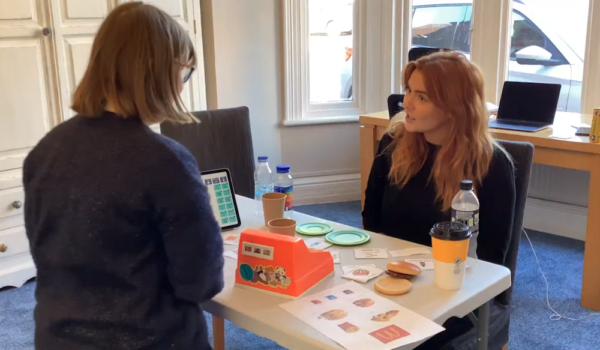
- Role-playing real-world situations like ordering at McDonald’s, Pizza Hut, cafes and ice-cream shops.
- Sharing ‘recent news’ using a mix of speech, photos and her device.
Everyday situations and generalisation
As ‘A’ has become more familiar with her AAC device, she uses it with pride, not just in therapy sessions, but in real life.
We visited her school to support the use of her device in class. She showed her teachers and peers how it worked and used it to contribute in class.
Embracing new opportunties, we visited a local cafe where ‘A’ confidently ordered drinks, food and asked and answered questions using speech and her AAC device.
She was delighted with herself and shared “That was great, I’m pleased” after the cafe trip.
Confidence

Beyond our therapy sessions, AAC practice and functional use continues. ‘A’ now:
- Orders her own food and drinks at cafés and restaurants
- Uses her AAC to clarify her message when she’s not understood
- Feels more confident communicating in the community and classroom
- Has less ‘shut down’ moments when she is not understood – with some prompting, she will use her AAC device to find keywords
For ‘A’, her AAC device is more than a digital tool, it’s opened up so many new opportunities, enabling her to express herself and connect to the wider world.
Further Support & Reading